How the Nigerian Judiciary Can Stop a Government Policy (With Real Examples)
This article explains how Nigerian courts can review, suspend, restrain, quash or declare unlawful certain government policies and administrative actions. It is an educational guide, not a substitute for advice from a qualified Nigerian lawyer on a particular case.
Updated: September 4, 2026
Reading time: About 25 minutes
Written by: Samson Ese — Founder, Editor-in-Chief & Lead Writer, Daily Reality NG
How the Nigerian Judiciary Can Stop a Government Policy — With Real Examples
What happens when the Federal Government announces a policy that affects millions of Nigerians, but someone believes the government crossed a legal line?
There is a common assumption in Nigeria that once the President, a minister, a federal agency or a state government announces a policy, ordinary citizens simply have to obey it.
That assumption is incomplete.
Nigeria's constitutional system contains another institution capable of saying, in effect: you have the power to govern, but you must exercise that power within the law.
That institution is the judiciary.
The important point, however, is not that Nigerian judges can simply cancel any policy they dislike. They cannot. The judiciary is not a second executive branch and a court is not supposed to replace the government's policy judgment with its own merely because a judge would have chosen differently.
The real question is more precise:
If the answer is no, the legal consequences can be serious.
A court may temporarily stop implementation while the case is being heard. It may declare an action unlawful. It may restrain an agency from enforcing a particular measure. In an appropriate judicial-review case, it may quash an unlawful administrative decision through certiorari. It may prohibit a public authority from proceeding unlawfully. It may compel a public authority to perform a legal duty through mandamus.
Sometimes the result affects an individual.
Sometimes it affects an entire industry.
And sometimes, as Nigeria's 2023 naira redesign litigation demonstrated, a court's decision can affect an entire country.
Table of Contents
- What does it mean for a court to "stop" government policy?
- The constitutional foundation
- Policy disagreement is not the same as illegality
- Six major legal grounds for challenging government action
- The different court orders that can stop government action
- How an injunction actually works
- Why the Federal High Court matters
- When a State High Court becomes relevant
- What the Supreme Court can and cannot do
- Real Nigerian examples
- Example 1: The 2023 naira redesign
- Example 2: Lagos State and withheld local-government allocations
- Example 3: Local-government financial autonomy
- Example 4: The 2026 NBC injunction
- Example 5: The Ajaokuta concession dispute
- When the court does NOT stop the policy
- Why standing, jurisdiction and procedure matter
- What evidence makes a challenge stronger?
- Seven mistakes that can destroy a government-policy challenge
- A practical Nigerian decision framework
- The human cost: what policy legality means outside Abuja
- What has changed in 2026?
- What to watch over the next 6–18 months
- Key takeaways
- Frequently Asked Questions
- Questions for Nigerian readers
- Your 24-hour action
1. What Does It Mean for a Court to "Stop" Government Policy?
The phrase sounds straightforward, but legally it can describe several very different things.
When Nigerians say, "The court stopped the government," they may be talking about:
- a temporary interim injunction;
- an interlocutory injunction pending the determination of a case;
- a final or perpetual injunction;
- a declaration that an action is unlawful or unconstitutional;
- an order of certiorari quashing an administrative decision;
- an order of prohibition preventing a public authority from continuing an unlawful process;
- an order of mandamus compelling a public authority to perform a legal duty; or
- a constitutional decision that renders a particular legal or governmental action invalid.
These are not interchangeable.
An interim injunction can be granted at an early stage to preserve the position until the court can properly hear the parties. It does not automatically mean the claimant has won the substantive case.
An interlocutory injunction can preserve the position while litigation continues.
A final injunction is different because it forms part of the final determination of the dispute.
Certiorari is different again. Its function is associated with quashing certain unlawful decisions of public bodies.
Mandamus does not mean "the court will run the government." It is concerned with compelling performance of a public legal duty where the requirements for that remedy are satisfied.
This distinction matters because a headline saying "court stops policy" can make a temporary procedural order sound like a permanent national declaration.
2. The Constitutional Foundation: Why Government Is Subject to the Courts
The starting point is the Constitution of the Federal Republic of Nigeria.
Section 1 establishes constitutional supremacy. Government authority does not exist independently of the Constitution.
Section 6 vests judicial powers in the courts established under the Constitution and relevant laws.
This produces a simple constitutional principle:
The executive branch makes and implements policy. The legislature makes laws within its constitutional authority. The judiciary interprets the Constitution and laws and determines legal disputes falling within its jurisdiction.
That separation is not merely theoretical.
It becomes practical when a government action crosses a legal boundary.
For federal executive or administrative actions, Section 251(1)(r) of the Constitution expressly gives the Federal High Court jurisdiction over an action or proceeding for a declaration or injunction affecting the validity of executive or administrative action or a decision by the Federal Government or one of its agencies, subject to the constitutional provisions around jurisdiction and available redress.
That is one of the clearest constitutional answers to the question asked by this article.
The courts are not foreign observers looking at government from outside the system. Judicial review is part of the constitutional architecture through which governmental power is kept within legal limits.
3. Policy Disagreement Is Not the Same as Illegality
This is where many explanations of Nigerian judicial review go wrong.
Imagine that the Federal Government introduces a policy to encourage electronic payments.
You dislike it.
Your neighbour dislikes it.
Some businesses complain about the cost.
Another group argues that the policy is economically harmful.
None of those facts automatically means a court should cancel it.
Courts generally have to distinguish between the wisdom of a policy and the legality of the government's action.
A policy may be unpopular and still lawful.
A policy may be economically controversial and still lawful.
A policy may be politically unpopular and still lawful.
But a government cannot create legal authority merely by announcing something through a press conference.
If Parliament has not granted an agency a particular power, an agency cannot manufacture that power for itself.
If the Constitution requires a particular procedure, the executive cannot simply ignore the procedure because the policy is urgent.
If a government decision violates an enforceable constitutional right, the government may have to defend that decision before a court.
If a public authority makes a decision outside the limits of the statute that created or empowers it, judicial review can become relevant.
| Situation | Automatically enough to stop policy? | Why? |
|---|---|---|
| "I don't like the policy." | No | Disagreement is not itself a legal ground. |
| "The agency has no statutory power to do this." | Potentially | This raises an ultra vires/jurisdictional question. |
| "The Constitution was breached." | Potentially | Constitutional legality is a judicial question where the court has jurisdiction. |
| "The required procedure was not followed." | Potentially | Procedural illegality can undermine administrative action. |
| "The policy caused hardship." | Not by itself | Hardship may be relevant to evidence or remedy but does not automatically establish illegality. |
4. Six Major Legal Grounds for Challenging Government Action
There is no single magic phrase that wins a government-policy lawsuit.
But several recurring legal pathways are important.
Ground 1: Constitutional conflict
The government action may conflict with a provision of the Constitution.
This can involve constitutional allocation of powers, enforceable fundamental rights, federal-state relationships, separation of powers or another constitutional restriction.
Ground 2: Acting beyond statutory authority
This is often described through the idea of ultra vires.
In plain English: a public authority cannot exercise a power it does not legally possess.
An agency may have broad responsibilities, but "we regulate this sector" does not automatically mean "we can impose any rule we want."
Ground 3: Failure to follow mandatory procedure
Sometimes government possesses the substantive power but uses the wrong process.
That distinction became particularly important in the 2023 naira litigation, where the Supreme Court considered statutory notice requirements surrounding withdrawal of existing currency notes.
Ground 4: Violation of an enforceable right
Chapter IV of the Constitution protects fundamental rights, subject to the limitations contained in the Constitution itself.
Where government action infringes an enforceable right, the affected person may have a constitutional enforcement route, depending on the facts, forum and remedy.
Ground 5: Unlawful administrative decision-making
Administrative law exists partly because public officials make decisions affecting licences, permits, sanctions, regulatory enforcement and other interests.
Those decisions are not necessarily beyond legal scrutiny.
Ground 6: Government interference with legally protected constitutional or statutory arrangements
The 2004 Lagos State local-government allocation litigation is an important example of the Supreme Court examining the limits of presidential executive action against a constitutional financial arrangement.
5. The Court Orders That Can Actually Stop Government Action
Knowing the name of the remedy is useful because it tells you what the applicant is asking the court to do.
1. Interim injunction
This is generally aimed at immediate preservation of the position while the matter awaits fuller consideration.
It can be extremely powerful because government action can become practically irreversible once implemented.
2. Interlocutory injunction
This is intended to operate while the substantive dispute remains pending.
The applicant normally has to satisfy the court on the applicable principles governing interlocutory relief.
3. Perpetual/final injunction
A final injunction can restrain conduct as part of the court's final resolution of the dispute.
4. Declaration
A declaration asks the court to pronounce on the legal status of an action, right or relationship.
A declaration can be enormously important even when it does not look like the dramatic phrase "policy cancelled."
5. Certiorari
Certiorari is a judicial-review remedy associated with quashing an unlawful decision of an inferior court, tribunal or public authority in circumstances recognised by law.
The Federal High Court Civil Procedure Rules contain provisions for judicial-review applications involving mandamus, prohibition and certiorari, as well as declarations and certain injunctions.
6. Prohibition
Prohibition is forward-looking. It can be used to prevent an authority from continuing proceedings or acting outside lawful bounds where the legal requirements for the remedy are established.
7. Mandamus
Mandamus is generally concerned with compelling performance of a public legal duty.
It is not a general command allowing a court to tell an elected government exactly how to formulate policy.
6. How an Injunction Actually Works
This is one of the most misunderstood parts of Nigerian court litigation.
Suppose a regulator announces that it will begin enforcing a disputed rule next Monday.
If the affected party waits two years until the full case is completed, the eventual judgment may arrive after the business has already closed or the regulatory action has already produced its intended consequence.
That is where interim or interlocutory relief can become important.
The applicant may ask the court to preserve the position until the legal dispute can be properly determined.
- Government announces or begins an action.
- A claimant identifies a legally arguable basis for challenge.
- The appropriate court and procedure are determined.
- The claimant files the required process.
- Where urgency and the applicable legal tests justify it, temporary relief may be sought.
- The government or affected parties respond.
- The court determines whether interim/interlocutory relief should continue.
- The substantive case proceeds.
- The court eventually determines the underlying legal dispute.
That means a headline saying "court stops government policy" on Tuesday does not necessarily mean the policy has permanently disappeared on Wednesday.
The exact wording of the order matters.
7. Why the Federal High Court Matters So Much
For many federal-policy disputes, the Federal High Court is central.
Section 251(1)(r) of the Constitution specifically addresses proceedings seeking declarations or injunctions affecting the validity of executive or administrative action or decisions of the Federal Government or its agencies.
That provision is especially relevant when the dispute concerns a federal ministry, department, agency or other federal administrative action.
But there is an important warning.
Do not assume that every dispute involving the Federal Government belongs in the Federal High Court simply because the Federal Government is involved.
Jurisdiction is technical.
The Constitution, the subject matter, the identity of the parties, the legal basis of the claim and the remedy sought all matter.
A brilliant constitutional argument filed in the wrong forum can still fail.
8. When a State High Court Becomes Relevant
State governments also exercise extensive public powers.
A challenge involving a governor, state ministry, state agency or other state authority may therefore raise questions falling within the jurisdiction of a State High Court, depending on the nature of the claim.
Again, the mistake is thinking in terms of a simple formula:
"Federal = Federal High Court. State = State High Court."
That is too simplistic.
Jurisdiction must be determined from the actual cause of action and the governing constitutional and statutory provisions.
For example, fundamental-rights proceedings have their own constitutional and procedural architecture.
9. What the Supreme Court Can and Cannot Do
The Supreme Court of Nigeria is the apex court.
Its jurisdiction is both appellate and, in specific constitutionally defined circumstances, original.
The Supreme Court itself explains that its original jurisdiction includes disputes between the Federation and a State, or between States, involving questions of law or fact on the existence or extent of a legal right, alongside additional original jurisdiction created by law.
It is therefore wrong to think of the Supreme Court as a general trial court where every Nigerian can walk in and challenge a government policy directly.
Most disputes have to begin in an appropriate lower court.
The Supreme Court can then become involved through the appellate process where the constitutional and statutory requirements for an appeal are satisfied.
This explains why a case may travel from a High Court or Federal High Court to the Court of Appeal and eventually to the Supreme Court.
10. Real Nigerian Examples: When Courts Have Intervened
The strongest way to understand this subject is through actual cases.
11. Example 1: The 2023 Naira Redesign Litigation

Illustrative image of Nigerian naira banknotes.
If you want one Nigerian example that demonstrates the enormous practical power of judicial intervention, this is probably the clearest.
In 2023, litigation arose around the Central Bank of Nigeria's redesigned N200, N500 and N1,000 banknotes and the government's handling of the old notes.
The case reached the Supreme Court after states challenged the Federal Government's approach.
On March 3, 2023, the Supreme Court ordered that the old N200, N500 and N1,000 notes remain legal tender until December 31, 2023, and the judgment was widely reported as invalidating the Federal Government's implementation of the currency withdrawal policy.
The deeper lesson is more important than the headline.
The dispute was not simply:
"Some Nigerians don't like the currency redesign."
The legal dispute involved constitutional and statutory questions about governmental authority, procedure and the withdrawal of legal tender.
That is exactly the difference between policy disagreement and judicial review.
The human consequence was not theoretical
The cash shortage produced consequences far beyond political arguments in Abuja.
Investigative reporting later documented how people struggled to access healthcare and ordinary economic activity during the cash shortage.
For example, Punch reported the experience of Mutiat Adeoye, a resident of Abeokuta, who said she had only N5,000 of a payment exceeding N100,000 when she was seeking medical care during the cash crisis.
That figure is important because it demonstrates why government-policy litigation is not merely an elite constitutional argument.
A legal dispute about how currency is withdrawn can eventually become a question about whether someone can pay for transport, food, medicine or healthcare.
The Supreme Court's intervention therefore illustrates the full chain:
12. Example 2: Lagos State and the Withheld Local-Government Allocations

In Attorney-General of Lagos State v Attorney-General of the Federation, the Supreme Court dealt with a constitutional dispute arising from the Federal Government's withholding of statutory allocations associated with Lagos State's local governments.
The dispute developed after the Federal Government objected to Lagos State's creation of additional local government areas without the consequential constitutional action contemplated by Section 8.
The executive response included withholding allocations.
The Supreme Court considered whether the President possessed the constitutional power to suspend or withhold the statutory allocation due to Lagos State for the benefit of its constitutionally recognised local-government councils.
The judgment granted relief to Lagos State, including declarations concerning the President's lack of power to withhold the relevant statutory allocation and a perpetual injunction against such withholding in respect of the constitutionally recognised local-government councils.
This case is valuable because it shows something Nigerians sometimes forget:
The executive branch is powerful, but executive power is not identical to constitutional power.
The President may issue directives. But a presidential directive cannot automatically create a power that the Constitution does not confer.
13. Example 3: The 2024 Local-Government Financial Autonomy Judgment
On July 11, 2024, the Supreme Court delivered judgment in Attorney-General of the Federation v Attorney-General of the States concerning local-government financial autonomy.
The case was SC/CV/343/2024.
The certified judgment identifies the Attorney-General of the Federation as plaintiff and the state Attorneys-General as defendants.
The judgment became a major constitutional development concerning the financial position of Nigeria's 774 local government areas.
Secondary reporting described the ruling as giving local governments financial autonomy across the federation.
The broader lesson is that constitutional litigation can alter how the three tiers of government interact financially.
Again, this is not the judiciary "running government."
The court's job is to interpret the constitutional framework that government itself is required to operate within.
14. Example 4: The 2026 NBC Injunction
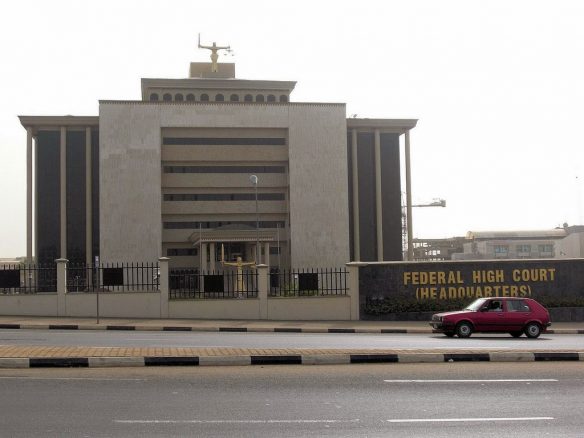
Federal High Court building in Lagos, used here as Nigerian judicial context.
This is particularly useful because it happened in 2026, not decades ago.
On May 4, 2026, Justice Daniel Osiagor of the Federal High Court in Lagos granted an interim injunction restraining the National Broadcasting Commission and its officers from enforcing, imposing sanctions or levying fines on broadcasting stations based on specified disputed provisions of the sixth edition of the Nigeria Broadcasting Code, pending determination of the motion on notice.
The order followed an application involving the Socio-Economic Rights and Accountability Project and the Nigerian Guild of Editors. The case concerned disputed regulatory provisions and a formal notice issued to broadcasters.
Notice the wording.
This was an interim injunction.
That means the responsible way to report it is not:
"The court permanently abolished the Broadcasting Code."
The more accurate description is that the court temporarily restrained the specified enforcement activity pending further proceedings.
That difference is not pedantic.
It is the difference between accurately reporting a court order and accidentally telling millions of readers that a final judgment has already been delivered.
15. Example 5: The Ajaokuta/NIOMCO Concession Dispute
Another useful example concerns the Ajaokuta Steel Complex and the National Iron Ore Mining Company.
In April 2023, the Kogi State High Court reportedly ordered the Federal Government to desist from proceeding with a concession process involving the assets pending determination of the case.
The order included restraint concerning a planned virtual prequalification conference.
The case illustrates the use of interim judicial intervention to prevent a disputed government process from moving so far ahead that the eventual court decision becomes practically meaningless.
But it also demonstrates why every case must be read according to its exact order.
A temporary order preserving the status quo is not the same thing as a final judgment declaring a government programme permanently unlawful.
16. When the Court Does NOT Stop the Policy
This is the part missing from many articles because it makes the story less dramatic.
Courts do not automatically side with whoever sues government.
There are cases in which applicants seek to stop a government action and fail.
That failure is important because it proves that judicial review is not a political switch that turns every controversial policy off.
For example, in April 2026, a Federal Capital Territory High Court dismissed a suit seeking to halt or restructure the renewal of a pipeline surveillance contract. Reporting on the decision said the court considered the requested intervention contrary to national economic interests. This is a useful counter-example: an applicant can ask a court to intervene and still fail to obtain the requested relief.
Likewise, in July 2026, the Court of Appeal in Lagos dismissed an interlocutory appeal by COSON concerning an injunction against the Nigerian Copyright Commission. The result reinforced the point that requesting an injunction does not mean the court must grant it.
There was also a 2026 example involving an ex parte order in a political-party dispute that was later set aside over procedural issues.
17. Why Standing, Jurisdiction and Procedure Matter
You can have a strong complaint and still lose the case because the legal vehicle is defective.
Standing / sufficient interest
The person bringing a judicial-review claim generally needs a legally sufficient interest or standing under the applicable rules and circumstances.
The Federal High Court rules have historically required sufficient interest before leave for judicial review is granted.
Jurisdiction
This is one of the biggest traps.
A court cannot hear a matter merely because the claimant believes that court is convenient.
Jurisdiction comes from the Constitution and statutes.
If jurisdiction is absent, the merits of the argument may never be reached.
Correct parties
The government authority whose decision is being challenged may need to be properly joined.
Where other parties have a direct legal interest, failure to involve necessary parties can create serious procedural problems.
Timing
Judicial review is not a "wait until you feel ready" exercise.
The Federal High Court Civil Procedure Rules contain time and procedural requirements for judicial review applications. The 2009 rules, for example, provide a three-month period for bringing an application for judicial review from the occurrence of the subject matter, subject to the rules and applicable legal context.
A lawyer must therefore determine the applicable current rule rather than assuming that an old procedural provision automatically governs every case today.
18. What Evidence Makes a Government-Policy Challenge Stronger?
One of the biggest mistakes is approaching litigation with anger instead of evidence.
A judge needs legal material, not just public outrage.
A useful evidence file can include:
- The original policy document.
- The enabling statute.
- The regulation, circular or directive used to implement it.
- The exact date the policy took effect.
- Evidence showing what government actually did.
- Evidence showing the claimant's legal interest.
- Correspondence with the relevant government body.
- Official notices and publications.
- Documents showing financial or operational consequences where relevant.
- Evidence supporting any allegation of procedural failure.
- The constitutional or statutory provisions allegedly breached.
- Previous judgments relevant to the legal question.
For a regulatory dispute, save the exact notice.
Do not rely only on a WhatsApp screenshot saying, "NBC has banned this."
Find the actual notice.
For a tax dispute, obtain the actual assessment or statutory instrument.
For a licensing dispute, obtain the licence, regulator's decision and enabling legislation.
For a constitutional challenge, identify the exact constitutional provision.
19. Seven Mistakes That Can Destroy a Government-Policy Challenge
Mistake 1: Suing because the policy is unpopular
Popularity is not the legal test.
Mistake 2: Choosing the court before identifying the cause of action
Start with the legal dispute, then determine the proper jurisdiction.
Mistake 3: Asking for an impossible remedy
A court cannot simply invent a remedy because the claimant is frustrated.
Mistake 4: Waiting too long
Delay can weaken urgency and may conflict with applicable procedural timelines.
Mistake 5: Treating an interim order as a final judgment
This is particularly common in social-media reporting.
Mistake 6: Failing to identify the exact government decision
"The government policy" is often too vague for serious litigation.
Mistake 7: Ignoring the government's legal defence
A serious claimant must anticipate arguments such as jurisdiction, statutory authority, procedure, standing, delay, public interest and the appropriateness of the requested remedy.
20. A Practical Nigerian Decision Framework
If you are trying to understand whether a government policy could realistically be challenged, use this sequence.
What exactly did the government do? Find the notice, circular, regulation, order or decision.
Who made the decision — President, minister, agency, governor, commissioner, regulator or another public body?
Which Constitution section, Act, regulation or other legal instrument gives the authority power to act?
Was the government outside its powers? Did it breach procedure? Did it violate an enforceable right? Did it contradict the Constitution?
Which court actually has jurisdiction?
Is the government about to take an irreversible step? If so, urgent interim relief may become relevant.
Is the case really asking for an injunction, declaration, certiorari, prohibition, mandamus or another remedy?
21. The Human Cost: What Policy Legality Means Outside Abuja
There is a tendency to discuss constitutional litigation as though it happens only between lawyers in Abuja.
It does not.
The ultimate reason these disputes matter is that government policy enters people's daily lives.
During the 2023 cash crisis, Mutiat Adeoye's reported experience in Abeokuta put a specific number on that reality: she said she had N5,000 available toward a hospital payment of more than N100,000 while seeking care.
That is not a theoretical constitutional problem.
It is a practical question of whether a person can access a service when the payment system around her is disrupted.
Similarly, a broadcasting regulation may sound like an industry dispute to someone in Abuja.
To a broadcaster in Lagos, however, a regulatory sanction can mean a lost contract, suspended programming, staff uncertainty and lost advertising revenue.
A local-government constitutional dispute can sound like federalism to a law student.
To a resident of a local government area, the argument eventually becomes about who controls public resources and what government delivers.
That is why judicial review matters.
It converts abstract governmental authority into a question that can be tested against actual law.
22. What Has Changed in 2026?
As of September 2026, the most important point is not that Nigeria suddenly acquired judicial review in 2026. Judicial review is much older than that.
The important development is that the mechanism remains actively relevant to contemporary government regulation.
The May 2026 NBC interim injunction is a clear example of a Federal High Court intervening during an ongoing regulatory dispute rather than waiting for the dispute to become historically irrelevant.
The Federal High Court also continued to maintain designated vacation courts in Abuja, Lagos, Port Harcourt and Enugu for urgent matters during its 2026 annual vacation period, demonstrating that urgent judicial work does not simply disappear during the general court vacation.
The Supreme Court's official website also continues to publish judgments and information about its jurisdiction and litigation functions, reinforcing the importance of checking the actual court record rather than relying exclusively on social-media summaries.
For readers, the practical lesson is simple:
In 2026, the question is not whether Nigerian courts can review government action. The question is whether the particular claimant has identified the correct legal basis, forum, evidence and remedy.
23. What to Watch Over the Next 6–18 Months
The next phase of Nigerian public-law litigation is likely to continue around the boundaries between executive power, regulation, constitutional federalism, elections, public finance and individual rights.
Several signals are worth watching.
1. Regulatory enforcement
As agencies become more aggressive in enforcing sector-specific rules, businesses and civil-society organisations will continue to test whether regulatory authority matches the legal powers granted by statute.
2. Federal-state disputes
Local-government autonomy has already demonstrated how constitutional litigation can reshape relationships among the three tiers of government.
3. Election-related litigation
With the Federal High Court issuing 2026 pre-election practice directions, procedural discipline around political litigation will remain important.
4. Digital and media regulation
The 2026 NBC litigation demonstrates how rapidly changing regulatory rules can produce constitutional and administrative-law disputes.
5. The importance of the exact court order
As court orders circulate instantly on social media, the difference between "interim injunction," "interlocutory injunction" and "final judgment" will become even more important for accurate public reporting.
24. Key Takeaways
- Yes, Nigerian courts can stop or restrict government action when a legally sufficient case establishes that the action is unlawful or otherwise warrants the remedy sought.
- That does not mean courts can cancel every policy they dislike. Courts principally determine legal questions within their jurisdiction.
- Section 251(1)(r) matters. It specifically addresses Federal High Court jurisdiction over declarations or injunctions affecting federal executive or administrative action.
- Interim relief is not the same as a final judgment.
- Jurisdiction can determine whether the case survives.
- Evidence matters. The exact policy document, enabling law and government decision should be identified.
- The 2023 naira litigation is a major example of judicial intervention in a nationwide government policy.
- The 2004 Lagos allocation case shows that executive power can be restrained by constitutional limits.
- The 2024 local-government autonomy judgment shows how constitutional litigation can reshape intergovernmental relationships.
- The 2026 NBC injunction shows that judicial intervention remains a live issue in Nigeria's regulatory environment.
- Not every challenge succeeds. Courts can refuse injunctions or dismiss claims where legal or procedural requirements are not met.
25. Frequently Asked Questions
1. Can a Nigerian court stop a presidential policy?
Yes, where the policy is implemented through an action or decision that falls within the court's jurisdiction and the claimant establishes a legal basis for judicial intervention. The court does not stop the policy merely because it is unpopular.
2. Can the Federal High Court stop a Federal Government agency?
Potentially, yes. Section 251(1)(r) specifically addresses proceedings involving declarations or injunctions affecting the validity of federal executive or administrative action or decisions by federal agencies.
3. Can a court stop a government policy temporarily?
Yes. Interim or interlocutory relief can be used where the applicable legal requirements are satisfied.
4. Does an interim injunction mean the claimant has won?
No. An interim injunction is not necessarily a final determination of the underlying dispute.
5. Can a court permanently cancel a government policy?
A court can grant final relief that renders a particular governmental action unlawful, invalid, restrained or otherwise legally ineffective where the law and facts justify that result. The exact remedy depends on the case.
6. What is judicial review in Nigeria?
Judicial review is the process through which courts examine the legality of decisions and actions of public authorities within their jurisdiction. The focus is generally legality rather than whether the judge personally prefers the policy.
7. What does ultra vires mean?
Ultra vires means acting beyond legal power or authority. In government litigation, it can arise where a public authority exercises a power that the law does not give it.
8. Can a court force a minister to perform a duty?
In an appropriate case, mandamus may be available to compel performance of a public legal duty. The remedy is not a general mechanism for telling a minister how to exercise a discretionary policy choice.
9. Can a court stop a government agency from enforcing a regulation?
Potentially, yes, if the claimant establishes the appropriate legal basis and satisfies the requirements for the requested relief. The 2026 NBC injunction is a recent example of temporary restraint against specified regulatory enforcement.
10. Can an ordinary Nigerian challenge government policy?
Potentially. The person's standing, legal interest, cause of action, constitutional or statutory basis and applicable procedure all matter.
11. Can hardship alone make a government policy illegal?
No. Hardship may be relevant to evidence and some remedies, but hardship alone does not establish that government acted unlawfully.
12. Can a court stop government because the policy is economically bad?
Not simply because the court considers the policy economically bad. The core question is normally whether the government acted within the law.
13. Can a governor's policy be challenged in court?
Yes, depending on the policy, the legal basis of the challenge, the parties and the court with jurisdiction.
14. Can the Supreme Court hear a government-policy case directly?
Only within its constitutionally defined original jurisdiction. Otherwise, the Supreme Court generally exercises appellate jurisdiction over matters coming through the required appellate route.
15. What is certiorari?
Certiorari is a judicial-review remedy associated with quashing certain unlawful decisions of public bodies or other bodies subject to the remedy.
16. What is prohibition?
Prohibition is a judicial-review remedy generally aimed at preventing an authority from continuing proceedings or acting outside lawful bounds where the legal requirements are met.
17. What is the difference between injunction and declaration?
An injunction restrains or requires conduct, while a declaration primarily states the legal position or rights of the parties. A case can involve one or more forms of relief depending on its circumstances.
18. Why can a government-policy lawsuit fail even when the policy looks unlawful?
Possible reasons include lack of jurisdiction, insufficient standing, wrong procedure, delay, failure to establish the alleged legal breach, inadequate evidence, failure to join necessary parties or failure to satisfy the test for the requested remedy.
19. Does filing a lawsuit automatically stop government action?
No. Filing a lawsuit and obtaining an order are different things.
20. Why should Nigerians read the actual court order?
Because a headline may say "court stops policy" while the actual order may only temporarily restrain a specific action pending a later hearing.
21. Can a court review government action during a policy implementation process?
Yes, depending on the legal basis, jurisdiction and remedy. Urgent judicial relief can sometimes be sought before an irreversible government action occurs.
22. What was the importance of the 2023 naira case?
It demonstrated that a nationwide government policy involving currency can be subjected to constitutional and statutory judicial scrutiny, with the Supreme Court issuing consequential orders regarding the old notes.
23. What did the Lagos allocation case demonstrate?
It demonstrated that presidential executive action affecting constitutionally protected financial arrangements can be subjected to judicial scrutiny and restraint.
24. Does every government agency have unlimited regulatory power?
No. Regulatory power must come from the legal framework governing the agency.
25. What should someone do before challenging a government policy?
Identify the exact government action, obtain the relevant documents, identify the enabling law, determine the alleged legal breach, establish the appropriate forum and obtain advice from a qualified Nigerian lawyer about procedure and remedy.
26. Questions for Nigerian Readers
Use these questions to test whether you understand the difference between government policy and government power:
- Have you ever experienced a government policy that affected your business directly?
- Did the authority explain the legal basis for the policy?
- Could you identify the statute behind the government action?
- Do you know the difference between an interim injunction and a final judgment?
- Why do you think courts should review executive power?
- Where should the line be drawn between judicial intervention and policy-making?
- Should economic hardship alone justify judicial intervention?
- What did the 2023 naira litigation teach Nigerians about government power?
- Do you think government agencies sometimes exercise powers broader than the law gives them?
- How important is it for journalists to publish the exact wording of court orders?
- Should a government policy be suspended immediately whenever a credible constitutional challenge is filed?
- What safeguards should exist before courts issue interim orders against government?
- How can citizens better understand the laws behind government policies?
- Should Nigerian courts publish more accessible explanations of important judgments?
- Which government policy area do you think requires the greatest public understanding of constitutional limits?
27. Your 24-Hour Action
Begin with five documents.
- Find the exact government announcement.
- Find the actual regulation, circular, notice or directive.
- Find the law that supposedly gives the government authority.
- Write down the exact part of the policy you believe is unlawful.
- Write down the practical consequence you are experiencing.
Then take those documents to a qualified Nigerian lawyer and ask a much better question:
"What is the legal basis for challenging this particular government action, which court has jurisdiction, and what remedy is realistically available?"
That question is far more useful than simply asking whether the government policy is unfair.
Final Verdict
So, can the Nigerian judiciary stop a government policy?
Yes — but not simply because the judiciary dislikes the policy.
The constitutional system is more disciplined than that.
The government has policy-making authority. But that authority operates within the Constitution, statutes and other applicable law.
When an executive or administrative action crosses a legal boundary, the courts can become the institution that tests that boundary.
The remedy may be temporary or permanent.
It may restrain enforcement, quash a decision, compel a public duty, declare an action unlawful or produce another legally appropriate result.
The 2023 naira litigation shows how consequential this can become nationally.
The 2004 Lagos allocation case shows that presidential power can be restrained by constitutional limits.
The 2024 local-government judgment shows how constitutional litigation can reshape the relationship between levels of government.
The 2026 NBC injunction shows that this is not merely history; judicial review remains an active part of Nigeria's regulatory landscape.
But the opposite lesson is equally important.
Not every policy challenge succeeds.
Not every hardship creates a legal claim.
Not every injunction is permanent.
And not every court has jurisdiction over every dispute.
The real power of Nigerian judicial review therefore lies in something more precise than "the court can stop government."
It lies in the constitutional principle that government must be able to show where its legal power comes from and must exercise that power within the boundaries imposed by law.
That is what separates a functioning constitutional system from government by unchecked instruction.
Sources & Further Reading
- Constitution of the Federal Republic of Nigeria — PLAC consolidated text
- Supreme Court of Nigeria — Jurisdiction
- Supreme Court of Nigeria — Judgments
- Federal High Court of Nigeria
- Federal High Court Civil Procedure Rules — Judicial Review provisions
- A.G. Lagos State v A.G. Federation (2004)
- Channels Television — 2023 Naira Redesign Supreme Court Decision
- Punch — 2026 Federal High Court NBC Injunction
- Samson Ese — Author Profile, Daily Reality NG
Author Bio

Samson Ese is the Founder, Editor-in-Chief and sole writer of Daily Reality NG. I writes from Warri, Delta State, about Nigerian legal, financial, regulatory and digital systems, translating complex institutional information into practical explanations for everyday Nigerians.
This article is for general educational information. Nigerian law is fact-specific and can change through legislation, court decisions and procedural rules. Readers dealing with an actual dispute should obtain advice from a qualified Nigerian legal practitioner.
© 2026 Daily Reality NG — Empowering Everyday Nigerians.


Comments
Post a Comment