How to Detect Fake Software Reviews Before Downloading
How to Detect Fake Software Reviews Before Downloading Anything
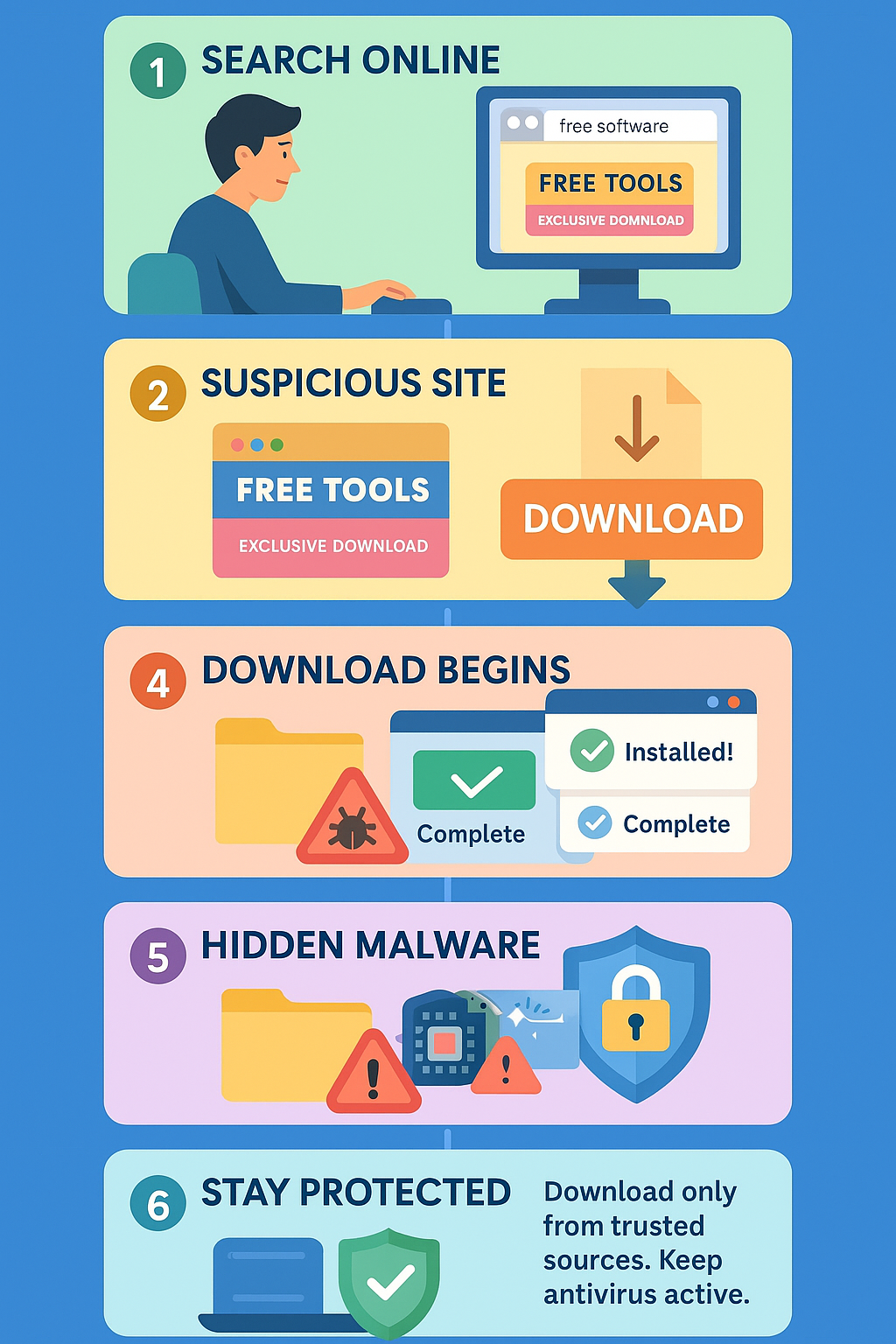
The danger is not simply downloading the wrong application. The bigger problem is being persuaded that the wrong application is trustworthy before you download it.
A convincing review is not the same thing as convincing evidence.
That distinction is the starting point for everything in this guide.
Imagine a Nigerian student looking for a PDF editor on a phone. Or a freelancer looking for screen-recording software. Or a small-business owner searching for an invoice application. Or someone trying to install a security tool after seeing a frightening message that says their device is infected.
The search looks ordinary. The decision feels ordinary. But the page in front of you may be designed around one objective: make you trust the software quickly enough that you stop checking.
That is why fake software reviews are more dangerous than simply “bad reviews”. A bad review may waste your time. A deceptive review can remove the doubt that would otherwise have stopped you from installing something you should never have installed.
Official reference: FTC malware protection guidance.
- Yes, proceed carefully: official source confirmed, developer verified, reviews contain specific experiences, no major unexplained warning signs, permissions make sense and pricing is clear.
- Pause: rating is unusually high but reviews are vague, developer identity is unclear, reviews appeared suddenly or the software is promoted aggressively.
- Do not download: unofficial source, impersonation, suspicious domain, pressure tactics, unexplained permissions, fake security warning, deceptive subscription or strong evidence of manipulated reviews.
Clear promise: by the end of this article, you will have a repeatable method for separating useful software reviews from suspicious review patterns, verifying the developer behind the software, deciding when a high rating deserves trust, and knowing what to do if you already downloaded something questionable.
- Why fake software reviews matter
- What a fake review actually means
- The Daily Reality NG seven-minute review test
- How suspicious review language gives itself away
- Review patterns that deserve investigation
- Why low-star reviews can be more useful
- How to verify the developer
- How to verify the download source
- Permissions, privacy and software behaviour
- Why a high rating can still mislead you
- What Google Play's rules tell you
- What Apple's App Store rules tell you
- What the FTC says about fake reviews
- The Nigerian download problem
- Original Nigerian illustrative scenarios
- Review evidence comparison table
- The download decision tree
- The three-minute emergency check
- If you already downloaded it
- Common mistakes
- The complete pre-download checklist
- Your 24-hour action plan
- Your seven-day digital-safety reset
- What fake reviews will look like next
- Frequently Asked Questions
- Related Daily Reality NG reading
The real problem is not fake reviews. It is manufactured trust.
When people talk about fake software reviews, the conversation often becomes a hunt for obvious spelling mistakes. That advice is no longer enough.
A suspicious review can be perfectly grammatical. It can use natural language. It can mention the software's name correctly. It can even describe a feature that genuinely exists.
The question is therefore not:
“Does this review sound like a human wrote it?”
The better question is:
“Does this review provide credible evidence that a real user had the experience being claimed?”
That is a much harder test.
Google Play explicitly prohibits manipulation of ratings, reviews and install counts, including fraudulent or incentivised reviews. Apple similarly prohibits manipulating App Store reviews, ratings and discovery. The FTC's consumer-review rule also addresses fake or false reviews and certain compensated review practices.
Those policies matter to you because they establish something important: review manipulation is not an imaginary problem created by suspicious users. Major platforms have formal systems and rules addressing it.
But there is a second lesson.
Platform moderation does not remove your responsibility to evaluate what you see.
Think of an app store like a supermarket with security staff. The presence of security reduces risk. It does not mean you should buy every product without looking at the label.
What exactly counts as a fake software review?
A fake review is not simply a review you disagree with.
A review can be negative and still be genuine. A review can be positive and still be genuine. A review can be badly written and still come from a real user.
The concern arises when the review misrepresents who wrote it, whether the person actually used the product, what experience they had, or whether the review was created or manipulated to influence other consumers.
The FTC's final rule specifically addresses fake or false consumer reviews and testimonials, including reviews that misrepresent that the reviewer exists or had actual experience with the product. It also addresses certain review incentives and other deceptive practices.
For software buyers, this creates four useful categories.
| Review type | What it means | How much weight to give it |
|---|---|---|
| Specific genuine review | Describes a concrete experience with features, problems or results. | Moderate to high, especially when supported by other reviews. |
| Vague positive review | Uses broad praise without explaining what actually worked. | Low. |
| Suspicious coordinated review | Similar language, timing or promotional behaviour appears across many reviews. | Very low. |
| False or fabricated review | Claims an experience that did not occur or misrepresents the reviewer. | Zero. |
The Daily Reality NG seven-minute review test
You do not need to become a cybersecurity researcher before downloading a PDF reader.
You need a process.
Daily Reality NG's practical test is built around seven checks:
Do not judge an app from its overall rating. Look at what people are saying now.
Look for recurring technical, billing, privacy or performance complaints.
Real experiences usually contain details: what feature failed, what device was used, what happened after an update or what the person expected.
If many reviews appear to use the same vocabulary, sentence structure or talking points, investigate further.
Do not assume the name shown beside the app is the company you think it is.
Find the genuine developer website independently and compare the product details.
Look at permissions, privacy information, subscription terms and the purpose of the software.
If the first five checks look good but the developer cannot be independently verified, stop.
If the developer is legitimate but the reviews contain coordinated-looking language, pause.
If everything checks out, the risk is reduced — not eliminated.
How suspicious review language can reveal a problem
Language alone cannot prove that a review is fake.
That point is important.
Do not reject an app because someone writes poor English. Do not trust an app because someone writes excellent English.
Instead, examine the information density of the review.
Compare these two hypothetical reviews.
| Review A | Review B |
|---|---|
| “Excellent app! Very useful! Five stars. Everyone should download it.” | “On my Android phone, the export button worked for the first two files but failed after I selected more than ten pages. Reopening the app fixed it once, but the problem returned.” |
| Very little evidence. | Contains a specific interaction, condition and observed outcome. |
Review B is not automatically genuine. Someone could fabricate it.
But it gives you something to investigate.
Review A gives you almost nothing.
This is why Daily Reality NG recommends thinking in terms of evidence quality rather than emotional tone.
Warning language patterns
- Repeated superlatives with no explanation.
- “Best app ever” repeated across many accounts.
- Claims that the software is “100% safe” without evidence.
- Reviews that sound like advertising copy.
- Comments that mention unrelated promotions.
- Reviews that encourage people to download immediately.
- Reviews that appear to respond to each other unnaturally.
- Multiple comments describing exactly the same benefit in nearly identical language.
Again, none of these proves fraud by itself.
The red flag is clusters of signals.
The review patterns that deserve investigation
1. A sudden wall of praise
Suppose an application has very few reviews for months and then suddenly receives a large number of highly positive comments within a short period.
That does not automatically mean manipulation. A major marketing campaign, product launch or genuine update could produce increased interest.
But it is worth asking:
- Did the app release a major update?
- Did the company launch the product in a new market?
- Are the new reviews actually specific?
- Are the new reviews unusually similar?
- Do recent negative reviews tell a completely different story?
2. Reviews that sell instead of review
A review should primarily describe the user's experience.
When dozens of comments behave like advertisements, caution is appropriate.
“Download now.”
“This is the only app you need.”
“Everyone should install this immediately.”
Those statements do not tell you how the software behaved.
3. Identical talking points
If several reviews independently mention the same unusual phrase, feature order or marketing slogan, investigate.
One explanation could be that users copied the same official marketing description.
Another could be coordinated review activity.
Your job is not to determine which one is true from the reviews alone. Your job is to recognise that the evidence deserves additional verification.
4. Perfect ratings with no meaningful criticism
Real software has limitations.
Even good applications can have bugs, compatibility problems, confusing interfaces, device-specific issues or features that some users dislike.
A review section containing only enthusiastic praise is not proof of manipulation, but it gives you less useful information than a review ecosystem containing specific positive and negative experiences.
5. The review history does not match the product history
If software has undergone major changes, older reviews may no longer describe the current product.
This is one of the most overlooked problems with ratings.
A four-year-old five-star review may describe a completely different version.
That is why recent reviews matter.
Why low-star reviews can be more valuable than the headline rating
Suppose an app has a 4.7-star average.
You could stop there.
Or you could read the one-, two- and three-star reviews.
The second approach is usually more informative.
Low-rated reviews can reveal:
- unexpected subscriptions;
- features that disappear behind a paywall;
- crashes after updates;
- device compatibility problems;
- excessive advertising;
- account restrictions;
- privacy complaints;
- poor customer support;
- misleading descriptions;
- billing confusion.
But there is a trap here too.
Do not assume every one-star review is truthful.
Someone can be angry because they misunderstood the product. Someone can dislike a legitimate feature. Someone can also post a review for the wrong application.
The useful question is:
“Do several independent low-rated reviews describe the same problem?”
Repeated, specific complaints deserve much more attention than one emotional outburst.
How to verify the developer behind the software
This is one of the strongest checks you can perform because fake software often depends on impersonation.
Imagine you are looking for software made by a company called Example Technologies.
You find an application called Example Secure.
The developer name is “Example Secure Technologies Ltd”.
That sounds convincing.
But sounding convincing is not verification.
Go to the company's official website independently.
Do not rely on a link inside a suspicious advertisement.
Compare:
| Verification point | What to compare | Red flag |
|---|---|---|
| Developer name | Store listing vs official website | Unexplained mismatch |
| Website | Official domain vs download domain | Look-alike domain |
| Product name | Official product page vs listing | Extra words or strange spelling |
| Icon | Official branding vs listing | Minor imitation |
| Version | Official release information | Impossible or inconsistent version |
| Support | Official support channel | Only generic email or messaging contact |
Apple's current developer guidelines emphasise accurate, verifiable information about developers and their offerings. Apple also prohibits manipulation of App Store reviews and discovery.
How to verify the download source
This may be the most important lesson in the entire article:
A good review does not make a bad download source safe.
You can have 10,000 apparently positive comments and still be looking at the wrong website.
The FTC specifically warns consumers about bogus software advertisements and recommends navigating to a website you know is genuine rather than clicking advertisements to download software.
That is especially relevant when searching for popular software.
A criminal does not necessarily need to invent a new software brand. It can be easier to imitate something people already want.
For example, the search journey might look like this:
The user thinks the review caused the decision.
In reality, the entire journey may have been designed to manufacture confidence.
Reviews are not enough: check permissions and privacy
Suppose an application claims to be a simple calculator.
Now imagine it asks for access to information that appears unrelated to calculating numbers.
That mismatch deserves attention.
Permissions should make sense in relation to the software's function.
A video editor may legitimately need access to photos or videos. A navigation application may need location access. A messaging application may need access to communication features.
The key question is not whether an application requests permissions.
The key question is:
“Why would this particular software need this particular access?”
If you cannot answer that question, stop before installing.
Apple provides privacy information on App Store product pages, including summaries of categories of data an app may collect or use.
Why a 4.8-star rating can still mislead you
Star ratings compress complicated information into one number.
That is convenient.
It is also dangerous when treated as a conclusion.
Consider two applications.
| Signal | App A | App B |
|---|---|---|
| Average rating | 4.8 | 4.4 |
| Recent reviews | Mostly vague praise | Detailed experiences |
| Developer identity | Difficult to verify | Matches official developer |
| Official website | Unclear relationship | Directly lists the app |
| Low-star reviews | Repeated concerns | Mixed but specific complaints |
| Privacy information | Unclear | Available |
Which would you investigate further?
Daily Reality NG would investigate App B first.
The reason is simple: evidence quality beats rating height.
What Google Play's current rules tell you about reviews
Google Play's developer policy explicitly prohibits manipulation of ratings, reviews and install counts. Its examples include incentivising users to leave ratings, repeatedly submitting ratings while pretending to be different users and using deceptive methods to influence app placement.
That gives users an important principle.
If you see reviews that appear to exist mainly to push the application upward rather than describe genuine experience, do not treat them as ordinary customer evidence.
Google also provides a mechanism for users to flag applications and reviews that violate its policies.
Use that mechanism when appropriate.
Do not download suspicious software simply because you want to investigate it personally.
What Apple's App Store rules tell you about fake ratings
Apple's current App Review Guidelines explicitly prohibit manipulating ratings, reviews or App Store discovery. Apple states that attempts to inflate rankings through paid, incentivised, filtered or fake feedback can trigger enforcement.
Apple also maintains systems for detecting fraudulent ratings and reviews. Its published 2026 reporting states that, during 2025, Apple processed more than 1.3 billion ratings and reviews and identified and blocked close to 195 million fraudulent ratings and reviews from appearing.
Those numbers should not make you careless.
They should make you understand the scale of the integrity problem.
If Apple itself operates large-scale systems to detect fraudulent review activity, the rational consumer response is not “reviews are useless”. It is “reviews are useful evidence, but I should interpret them critically.”
What the FTC's fake-review rule tells consumers
The U.S. Federal Trade Commission's final rule on consumer reviews and testimonials prohibits several deceptive practices involving fake or false reviews. The rule addresses reviews that misrepresent the reviewer or experience, buying or selling reviews in prohibited circumstances, certain undisclosed insider reviews, review suppression and fake social-media indicators used commercially.
For a Nigerian reader, the important lesson is not that a U.S. rule automatically governs every Nigerian software transaction.
It does not.
The useful lesson is that major consumer-protection authorities recognise manipulated reviews as a genuine marketplace problem.
Therefore, when an online software listing appears to manufacture trust through reviews, it is sensible to verify the product independently.
The Nigerian download problem: why verification matters even more
Nigerian internet users often make software decisions under practical constraints that international security guides do not always discuss.
Data can be expensive. Devices can be older. Storage can be limited. People frequently share software recommendations through WhatsApp groups. A person may download an APK because a friend sent it. Someone may search for a free alternative because the official paid version is expensive in naira terms.
None of these behaviours makes someone careless.
They simply create more opportunities for an unverified download to look attractive.
For example, a message in a WhatsApp group might say:
“This app is the latest version. Download it here. It has 5-star reviews.”
The temptation is understandable.
But the correct question is not whether the sender is someone you know.
The correct question is whether the software itself can be verified.
A trusted person can unknowingly forward a dangerous link.
That is why source verification must happen independently.
Original Nigerian illustrative scenarios
The following are illustrative scenarios created specifically for this article. They are not presented as real people or documented incidents.
Scenario 1: The student and the “perfect” PDF app
A university student searches for a PDF editor.
One app has 4.9 stars.
Almost every recent review says:
“Amazing.”
“Perfect.”
“Best PDF app.”
He is about to install it.
Then he checks the developer.
The developer name does not match the company website.
He searches the official company independently and discovers that the official product has a different developer identity.
Decision: do not install.
The star rating did not save him. The developer check did.
Scenario 2: The freelancer and the fake security warning
A freelancer visits a website and receives a warning claiming that the computer is infected.
A button says “Install protection now”.
Underneath the download link are dozens of glowing comments.
The comments create urgency.
The freelancer does not download.
Instead, the person closes the warning and navigates to a known security provider independently.
This is the correct response to an unexpected security warning.
The FTC warns consumers about bogus software advertisements and fake technical-support warnings designed to persuade people to download software or hand over access.
Scenario 3: The small business owner and the subscription trap
A small business owner needs a simple invoice application.
The app has thousands of positive reviews.
The owner reads the lower-rated comments and notices several people complaining about unexpected subscription charges.
The owner checks the pricing page and discovers that the free trial automatically converts into a paid subscription unless cancelled under the stated terms.
Decision: the app may be legitimate, but it is not necessarily the right choice.
This illustrates an important distinction: legitimate software can still be a bad purchase.
The Daily Reality NG review-evidence matrix
Use this table when you want a quick structured assessment.
| Signal | Low concern | Medium concern | High concern |
|---|---|---|---|
| Review specificity | Detailed experiences | Mixed detail | Generic praise |
| Review timing | Natural spread | Some clustering | Unusual burst |
| Repeated wording | Rare | Some overlap | Strong repetition |
| Low-star reviews | Specific and mixed | Some recurring issues | Many matching serious complaints |
| Developer identity | Clearly verified | Needs checking | Cannot verify |
| Download source | Official | Recognised marketplace | Unknown or suspicious |
| Permissions | Logical | Some questions | Clearly excessive |
| Pressure | None | Marketing urgency | Threat or countdown |
Decision rule: one medium concern does not necessarily mean “fake”. Multiple high-concern signals should make you stop.
The Daily Reality NG download decision tree
Do you know exactly what software you are looking for?
↓ YES → Can you identify the official developer?
↓ NO → Stop and establish the correct product first.
↓ YES → Does the official developer list the same product?
↓ NO → Stop.
↓ YES → Is the download source official or a recognised platform?
↓ NO → Stop.
↓ YES → Do reviews contain specific, independent experiences?
↓ NO → Investigate further.
↓ YES → Do recent low-rated reviews reveal repeated serious problems?
↓ YES → Pause and investigate.
↓ NO → Check permissions, privacy and pricing.
↓ Everything makes sense → Download only if you are comfortable with the remaining risk.
The three-minute emergency check
Sometimes you genuinely need software quickly.
Use this compressed version:
- Check the developer.
- Check the official website.
- Read the newest reviews.
- Read several one-star reviews.
- Look for repeated language.
- Check permissions.
- Check pricing and subscription terms.
- Confirm that the download source is genuine.
If anything feels wrong, do not let urgency make the decision for you.
There is an important asymmetry here:
Waiting five minutes costs five minutes.
Recovering from a compromised account can cost much more.
What to do if you already downloaded suspicious software
Do not panic.
Downloading a suspicious application does not automatically mean your device has been compromised.
But if you have reason to believe the software is malicious or deceptive, take the situation seriously.
Do not enter additional passwords, banking information or identity details into the suspicious application.
This can reduce the ability of malicious software to communicate while you assess the situation.
Update your security software and perform an appropriate scan.
Use the normal security and application-management tools provided by your device.
If you suspect your credentials may have been exposed, change passwords from a device you trust.
This adds another barrier to account takeover.
If banking information may have been exposed, contact your bank through an official channel.
The FTC similarly recommends stopping sensitive account activity when malware is suspected, running a security scan, changing passwords and enabling two-factor authentication.
Seven mistakes people make when judging software reviews
Mistake 1: Looking only at the average rating
A star rating is a summary, not an investigation.
Mistake 2: Reading only five-star reviews
Five-star comments tell you why some users liked the software. They do not necessarily tell you what can go wrong.
Mistake 3: Assuming bad grammar means fake
Language ability is not evidence of authenticity.
Mistake 4: Assuming perfect English means genuine
The reverse is equally wrong.
Mistake 5: Trusting the first search result
Search placement is not developer verification.
Mistake 6: Installing first and investigating later
For sensitive software, reverse the order: investigate first, install second.
Mistake 7: Treating a friend's recommendation as proof
A friend can recommend something honestly and still be mistaken. The recommendation is a reason to investigate, not a substitute for verification.
The complete pre-download checklist
- □ I know exactly what software I need.
- □ I know the legitimate developer.
- □ I have independently found the developer's official website.
- □ The official website confirms the product exists.
- □ The developer name matches or can be logically explained.
- □ The download source is appropriate.
- □ I have read recent reviews.
- □ I have read low-rated reviews.
- □ The reviews contain specific experiences rather than only praise.
- □ I did not see a suspicious cluster of repeated language.
- □ The permissions make sense.
- □ The privacy information is available.
- □ I understand whether the software is free, paid or subscription-based.
- □ I know how to contact legitimate support.
- □ I am not being pressured by a countdown, warning or threat.
- □ I did not reach the download through an unexpected message or suspicious pop-up.
- □ I have checked the current version and update information.
- □ I understand what the application actually does.
What Daily Reality NG would check first
If this were an editorial investigation into an unfamiliar application, the first question would not be “How many stars does it have?”
The first question would be:
“Who actually made this?”
Then:
- Who owns the official domain?
- Does the company list the application?
- Does the store developer match?
- Does the product name match?
- Do recent users describe the same product?
- Are there complaints about billing or privacy?
- Does the software ask for access that makes sense?
This approach changes the investigation from “Which reviews should I believe?” to “Can I verify the product independently?”
That is a much stronger question.
Why official sources beat review roundups
Review websites can be useful for discovering software.
But when identity, security or financial risk is involved, the developer's official documentation should be part of your verification process.
For example:
- Use the official developer website to confirm the product.
- Use Google Play's official policies for Android review and listing concerns.
- Use Apple's official App Store guidance for Apple applications.
- Use government or recognised cybersecurity guidance for malware warnings.
The FTC's malware guidance recommends obtaining software from websites you know and trust and keeping security software and operating systems updated.
Your 24-hour action plan
Within 10 minutes: identify every application you recently installed because of a recommendation, advertisement or review.
Within 30 minutes: inspect the developer, source and recent reviews of anything you do not recognise.
Within 1 hour: remove software you cannot reasonably verify and do not need.
Within 3 hours: update your operating system and important applications.
Within 24 hours: review the permissions of sensitive applications and enable multi-factor authentication on important accounts.
The objective is not to become paranoid about every application.
The objective is to stop making software decisions entirely from star ratings.
Your seven-day digital-safety reset
| Day | Action | Purpose |
|---|---|---|
| Day 1 | Review installed applications. | Identify software you no longer recognise or need. |
| Day 2 | Review sensitive permissions. | Understand which apps access important information. |
| Day 3 | Update operating system. | Reduce exposure to known security issues. |
| Day 4 | Update critical apps. | Keep software current. |
| Day 5 | Review account security. | Strengthen passwords and MFA. |
| Day 6 | Save official support contacts. | Avoid relying on suspicious search results during an emergency. |
| Day 7 | Teach the review-verification method to family or colleagues. | Reduce risky downloads across your immediate network. |
What fake software reviews will look like next
The easiest mistake would be to think fake reviews are becoming harder only because scammers can write better English.
The deeper issue is that synthetic content can increasingly resemble ordinary human language.
That means old warning signs such as grammar mistakes should become less important.
The future-proof approach is to verify the relationship between evidence points.
Ask:
- Does the review match the product?
- Does the developer match the company?
- Does the company website match the store listing?
- Does the current version match the review period?
- Do low-rated and high-rated reviews describe the same product?
- Do permissions make sense?
- Does pricing match the promises?
This is harder to manipulate because it is not based on one piece of text.
It is based on consistency.
When a suspicious review does not mean the software is fake
This is an important balance.
Do not turn this article into a machine for accusing legitimate developers.
Reviews can look strange for innocent reasons.
A company may launch in a new country and receive many new users.
A major update may cause a sudden wave of reviews.
A popular creator may recommend an application and cause genuine downloads.
A product may have a large number of short reviews because its users are not highly technical.
Therefore, red flags are prompts for verification, not automatic verdicts.
That distinction protects both consumers and legitimate developers.
How to distinguish a bad app from a fake app
| Bad but legitimate software | Potentially deceptive software |
|---|---|
| Real developer | Developer identity unclear or impersonated |
| Official website exists | Official source cannot be established |
| Users report genuine limitations | Reviews appear manipulated |
| Pricing may be unpopular | Pricing may be hidden or deceptive |
| Product may crash or lack features | Product may be designed to impersonate another service |
| Support may be poor | Support identity may be fabricated |
That distinction matters because not every negative review is a security warning.
Sometimes the correct decision is simply:
“This software is legitimate, but it is not good enough for my needs.”
What if the reviews are all positive because the software is genuinely excellent?
That is possible.
A high rating is not suspicious simply because it is high.
The issue is whether the rating is supported by credible evidence.
If users describe specific experiences, the developer is verifiable, the official website confirms the product, the application behaves consistently with its description, permissions make sense and there are no major unexplained warning signs, a high rating can reasonably contribute to your decision.
The goal is not to distrust everything.
The goal is to trust intelligently.
What you should never use as your only safety test
- Star rating alone.
- Number of downloads alone.
- Number of reviews alone.
- A friend's recommendation alone.
- A YouTube recommendation alone.
- A search-engine ranking alone.
- A professional-looking logo alone.
- A polished website alone.
- Good grammar alone.
- Bad grammar alone.
- A “verified” looking badge unless you understand what it verifies.
Security decisions should be based on multiple independent signals.
How to build your own evidence hierarchy
When deciding whether to download software, Daily Reality NG recommends this hierarchy:
| Evidence | Weight |
|---|---|
| Official developer confirmation | Very high |
| Official app-store listing with matching developer | High |
| Current privacy and product information | High |
| Specific recent user experiences | Moderate |
| Independent reputable security analysis | Moderate to high |
| Generic positive reviews | Low |
| Anonymous recommendation | Low |
| Unexpected advertisement or pop-up | Very low trust |
One more important lesson: fake reviews can hide legitimate problems
Even when an application is not malicious, manipulated reviews can still cause harm.
They can hide poor customer support.
They can hide subscription complaints.
They can hide missing features.
They can make a weak product appear stronger than competitors.
That matters because your money and time are resources.
For a Nigerian freelancer working with expensive mobile data, repeatedly downloading applications that do not work is not merely annoying.
For a student with limited storage, unnecessary applications consume space.
For a small business owner, an unreliable application can interrupt operations.
For anyone using the same phone for sensitive accounts, the security consequences can be more serious.
Practical rule: investigate the software, not the hype
Here is the simplest version of the entire article:
Ignore the excitement for five minutes.
Find the developer.
Find the official website.
Confirm the product.
Read recent reviews.
Read low-rated reviews.
Look for patterns.
Check permissions.
Check pricing.
Then decide.
That process is boring.
That is exactly why it works.
Key takeaways
- A high star rating is evidence, not proof.
- Specific reviews are generally more useful than generic praise.
- Read recent low-rated reviews before downloading.
- Repeated wording across many reviews deserves investigation.
- Verify the developer independently.
- Verify the download source independently.
- Do not trust software advertisements simply because they appear in search results.
- Check permissions against the software's actual purpose.
- Check privacy and subscription information.
- Do not assume every suspicious-looking review is fake; investigate patterns.
- Google Play and Apple both prohibit review manipulation.
- Major platforms actively moderate fraudulent reviews, but users should still evaluate evidence critically.
- If you suspect malware, stop entering sensitive information and take recovery steps.
- For important software, official-source verification should outrank review popularity.
- The best protection is not paranoia. It is a repeatable verification process.
Frequently Asked Questions
How can I tell if a software review is fake?
Can a software have thousands of reviews and still be unsafe?
Is a 4.8-star rating enough to trust an app?
Why should I read one-star reviews before downloading software?
Can positive reviews be genuine and still be misleading?
Should I trust reviews that say an app is 100 percent safe?
What is the safest place to download software?
Can search-engine results contain fake software download pages?
Why are fake software reviews dangerous?
What should I check besides reviews?
Are app-store reviews completely trustworthy?
What should I do if an app has suspicious reviews?
Can AI-generated reviews be fake?
How do I compare reviews efficiently when I am in a hurry?
What should I do if I already downloaded suspicious software?
Related Daily Reality NG reading
If you want to build a broader digital-safety and technology-verification habit, these Daily Reality NG resources provide useful context:
The editorial bottom line
The most dangerous software review is not necessarily the obviously fake one.
The more dangerous review is the one that gives you just enough confidence to stop checking.
That is why this article does not tell you to become suspicious of every five-star rating.
It tells you to become suspicious of unsupported confidence.
If someone tells you an application is safe, ask how they know.
If a review tells you an application is perfect, ask what was actually tested.
If a search result tells you to download software immediately, ask whether you independently verified the website.
If an application requests access to information unrelated to its purpose, ask why.
If the developer identity does not line up, stop.
If several reviews suddenly repeat the same language, investigate.
If a security warning pressures you to install something immediately, step away from the warning and verify the problem through a trusted source.
And if you remember only one sentence from this entire guide, remember this:
Reviews can help you choose software, but reviews should never be the only reason you trust software.
The strongest decision combines independent developer verification, a trustworthy download source, useful review evidence, sensible permissions, clear privacy information and a product that actually matches what you need.
That takes a few more minutes.
Those minutes are not wasted.
They are the price of making the decision before the software makes it for you.

Samson Ese is the founder and editor-in-chief of Daily Reality NG, an independent Nigerian digital publication based in Warri, Delta State. My editorial work focuses on practical Nigerian realities across technology, digital safety, personal finance, business, regulation and everyday decision-making. This article was researched as a consumer-technology guide and built around primary-source platform policies and authoritative cybersecurity guidance rather than competitor rewrites.


Comments
Post a Comment